
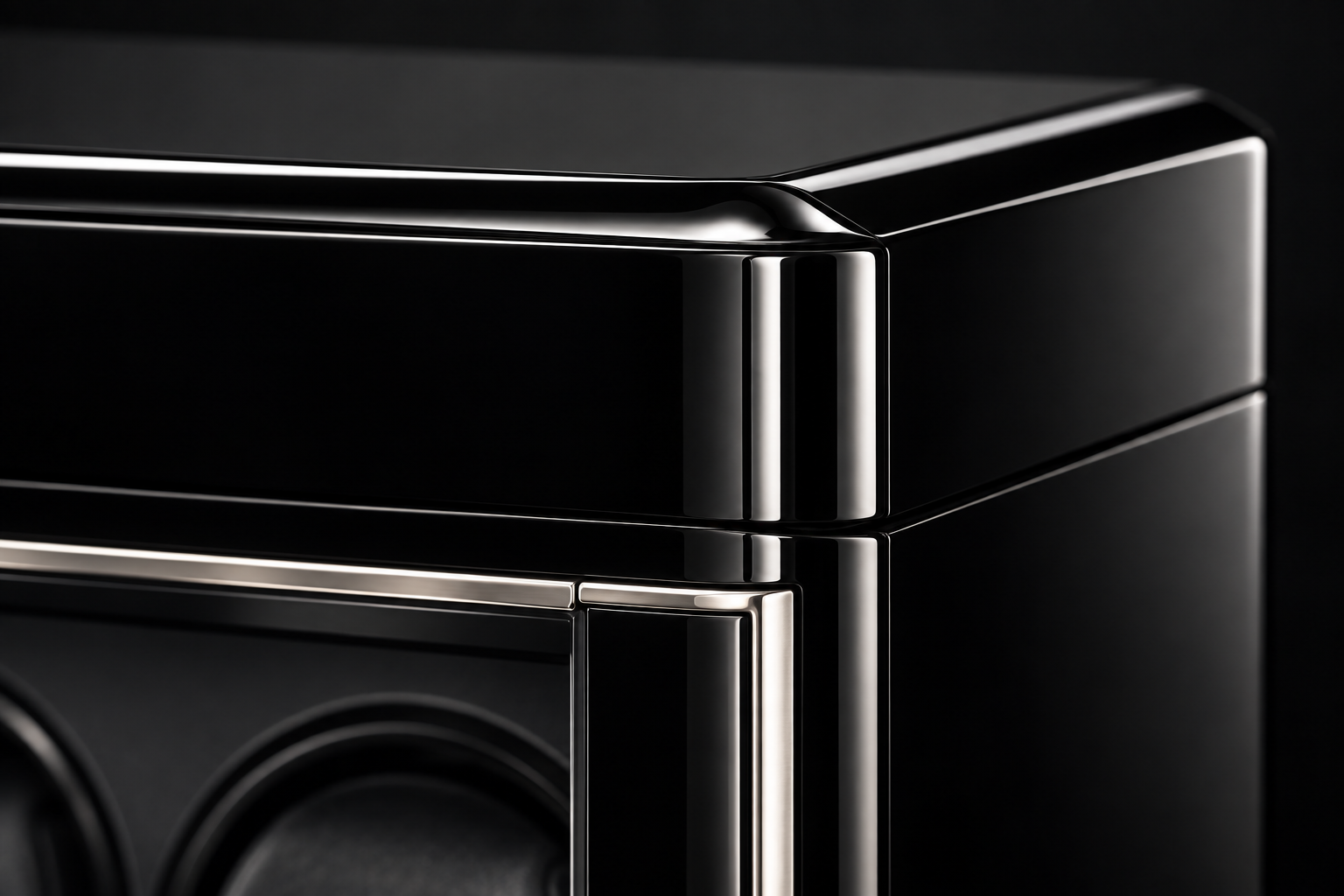
A luxury humidor should be satisfying to use every time you open it. Its exterior matters, but so do the interior lining, closure, tray arrangement and hardware. This buying guide offers a practical way to compare those details without relying on a brand name or a polished photograph alone.
Start by separating two questions: how is the cabinet built, and how will it work for your collection? A beautiful finish deserves close inspection, while the storage layout needs to fit your cigars and habits.
Read the material description carefully
“Wooden humidor” can describe several constructions. Look for a specification that identifies the outer cabinet, interior lining and trays separately. A Spanish cedar-lined interior does not mean the entire cabinet is solid Spanish cedar, nor does it need to mean that.
The clearest product descriptions tell you where each material is used. That makes it easier to compare construction rather than treating a vague phrase such as “premium wood” as a complete explanation.
Inside Noir Platinum, Spanish cedar is used for the humidor lining and cigar trays. Its exterior has a mirror-finished black lacquer surface. These descriptions refer to distinct parts of the cabinet, each with a different role.
Give the closure as much attention as the finish
Inspect the alignment around the lid and the meeting edges. Does the lid sit evenly? Does it open and close smoothly? Is there visible rocking, interference or an irregular gap?
A hands-on inspection can reveal a poorly fitted closure, but its appearance alone cannot certify humidity performance. Ask how humidity is controlled and monitored, and what setup and maintenance the owner must perform.
The maker's instructions should guide the preparation of a wooden humidor. Boveda, for example, explains that conditioning the wood before loading cigars helps prevent dry wood from taking moisture from them. Its seasoning process is a specific method, not a reason to assume every cabinet has identical setup instructions. [1]
Inspect lacquer in useful light
A reflective finish is easiest to assess when a light source crosses it. Look along the surface and around corners rather than examining only the center of the lid. Ask for close views of edges, trim intersections and the area surrounding the hinges.
You are looking for visual consistency: a reflection that suits the intended finish, neatly finished edges and transitions that look deliberate. A heavily retouched image cannot answer all of those questions, so detailed photographs or an in-person inspection are valuable when available.
“Mirror finish” describes an appearance. It does not establish scratch resistance, a coating thickness or a particular number of lacquer layers. Those claims require their own specifications.
Consider the hardware as working components
Hinges carry the lid during use, while fittings and access hardware are handled repeatedly. Ask about the hardware material, finish and replacement arrangements rather than judging quality only by its color.
Platinum-toned hardware describes a silver-colored appearance; it is not a claim that the fittings are solid platinum. Similarly, corrosion resistance should not be interpreted as immunity to every environment or cleaning product.
Noir Platinum pairs its exterior with heavy-duty, corrosion-resistant hinges and fittings. The hardware continues the cool silver tone of the cabinet's trim.
Check the storage layout with your cigars in mind
Make a short inventory of the formats you keep most often. Then compare their length and ring gauge with the usable tray space. Leave the humidification components and access clearances in the calculation rather than treating the cabinet's entire internal volume as cigar capacity.
A three-level arrangement can organize a collection, but accessibility matters too. Think about which cigars you reach for most often and how you would retrieve those on the lowest level.
Noir Platinum has three cigar-storage levels with an accessory area on the top level. A dedicated location for a lighter and cutter helps keep the contents organized without relying on loose accessories placed across the trays.
Use a consistent comparison checklist
Before making a decision, record the same information for every cabinet:
- Materials used for the body, lining and trays.
- Usable storage dimensions and any stated capacity assumptions.
- Closure and hinge operation.
- Humidification and monitoring arrangements.
- Exterior finish and care instructions.
- Service access, replacement parts and written support terms.
This gives you a useful comparison even when products have very different visual styles. It also makes unanswered questions easy to identify before purchase.
Explore the construction of Noir Platinum
Noir Platinum combines the upper cedar-lined humidor with a separate four-watch winding section, mirror-black lacquer and concealed RFID access. Read more about why Spanish cedar is used in humidors, or compare the layout considerations in our humidor and watch winder guide.
Frequently asked questions
Does a more expensive humidor automatically control humidity better?
Price alone does not establish performance. Compare the closure, humidity-control system, monitoring and owner instructions alongside the decorative finish.
Must the whole cabinet be Spanish cedar?
No. Ask specifically about the lining and trays, then assess the surrounding cabinet structure separately.
What should I ask about a high-gloss finish?
Ask about the finish specification, care instructions and detailed views of the surfaces and edges. Do not assume that gloss establishes scratch resistance.
Source
- 1. Boveda: How to Season Your Humidor. Accessed September 20, 2026. Referenced for the purpose of conditioning wooden interiors, not as a Noir Platinum operating manual.