
Choosing a Watch Winder With a Lock: RFID and Everyday Access
EMBER & HOUR · September 20, 2026
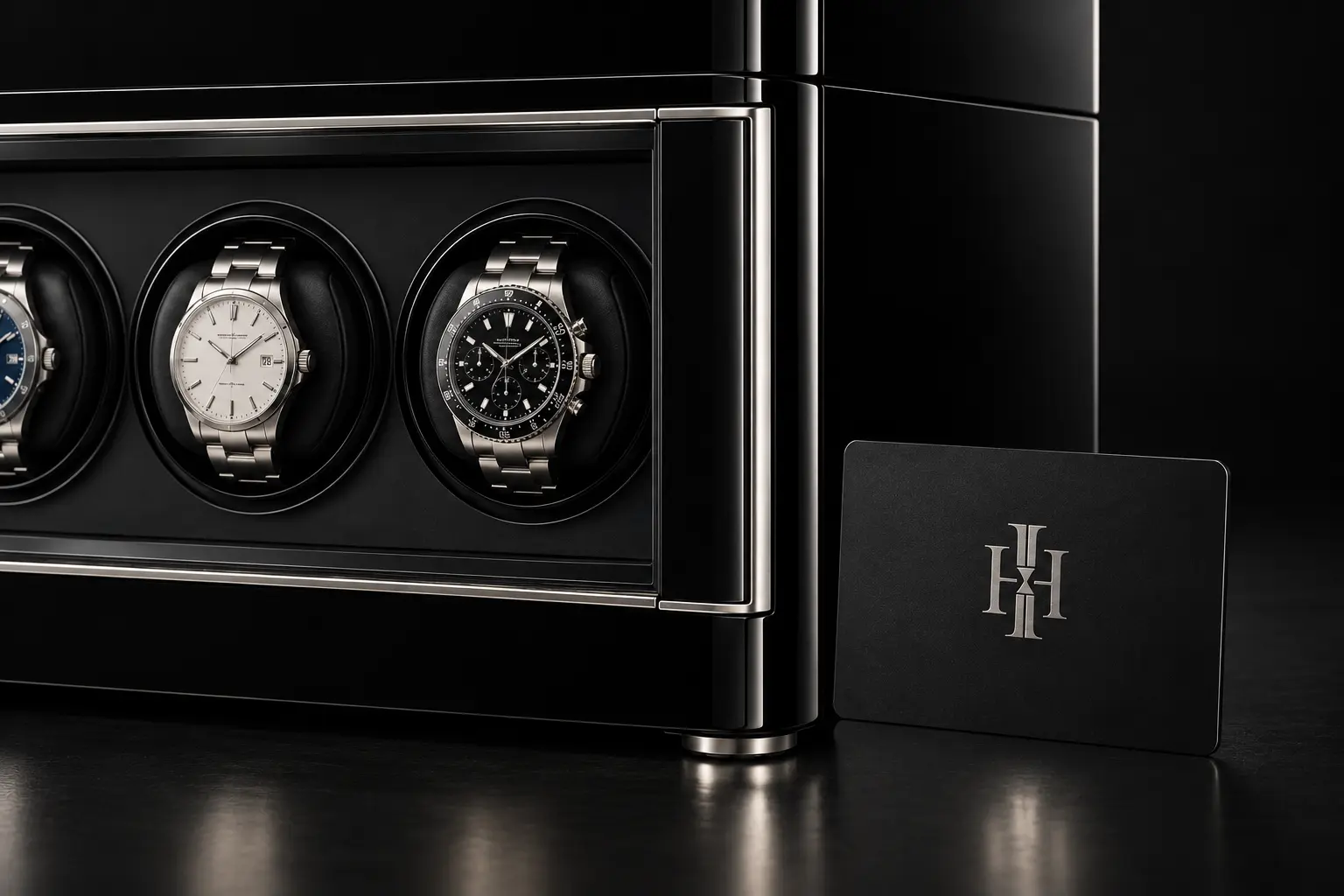
When choosing a watch winder with a lock, consider how you will open it, manage the keys or cards, and maintain the locking system. The most suitable arrangement should make everyday access straightforward while fitting the cabinet's design.
Concealed RFID is one approach. An authorized card is presented at the reader location to release the lock, allowing the exterior to remain free of a visible front keyhole. The complete specification matters, because different electronic locks handle credentials, batteries and recovery differently.
What an RFID lock does
RFID stands for radio-frequency identification. In this type of access system, a compatible credential communicates with a reader, and the system checks whether that credential is authorized before releasing the lock.
Furniture-lock manufacturer LEHMANN offers RFID systems with different reader and lock arrangements. Its M400 documentation, for example, distinguishes battery power, card programming and a particular emergency-power provision. Those details demonstrate why “RFID” alone is not a complete operating specification. [1]
When comparing cabinets, ask for the actual owner procedure rather than assuming every card-operated system works in the same way.
Compare the everyday access methods
A mechanical key gives you a physical item to insert and turn. A keypad uses a code. An RFID card is presented to a reader. Fingerprint systems use an enrolled fingerprint. Each changes what you carry, remember or manage.
For a minimalist cabinet, concealed card access offers a particular visual advantage: the front does not need an exposed key cylinder or keypad. The reader location should still be clear to the owner, even when it is visually discreet.
If several people will use the cabinet, think through who needs access and how credentials will be stored. A system that suits a personal collection may be used differently in a shared household.
Ask what happens after the door opens
The opening action is only part of the process. Ask how the cabinet relocks, how the owner knows it is locked and whether the operating instructions require a further card presentation or another action.
Do not assume automatic relocking from a photograph or from the word “electronic.” The latch and control system determine the sequence. A clear demonstration or written procedure should answer that question.
It is also worth checking the door itself. Smooth alignment and easy access to the watch cushions contribute to a satisfying daily routine alongside the lock mechanism.
Plan for spare cards and batteries
Keep a spare credential somewhere other than inside the compartment it opens. Ask the supplier about lost-card handling, replacement credentials and the documented process if the batteries become depleted.
Battery service should be understandable before it is needed. Look for a clear explanation of the compartment location and the authorized access procedure. Avoid assuming that the winding power supply also powers the lock.
Some systems have low-battery alerts or an emergency-power connection, but these features are hardware-specific. Confirm them for the exact cabinet. A feature found in another manufacturer's lock is not evidence that it is present in the cabinet you are considering.
Distinguish access control from safe construction
A lock controls an opening. A cabinet's resistance to forced entry or fire depends on additional construction and, where claimed, relevant testing. RFID identifies the access method; it does not establish a burglary or fire rating.
If you require a rated safe, compare the stated certification and installation requirements. For a display cabinet, evaluate the lock according to its documented function without treating its presence as an unstated security guarantee.
This distinction helps you ask better questions and choose a product for the role you want it to serve.
Concealed access on Noir Platinum
Noir Platinum uses a concealed RFID lock for its watch-winding compartment and includes two branded EMBER & HOUR owner cards. Present an authorized card at the concealed reader location to release the lock and open the single front door.
The front has no visible keyhole. An isolated, serviceable battery compartment supplies the lock, while an external wall transformer powers the four watch-winding positions through a conventional DC connection.
The upper humidor opens separately. Its Spanish cedar lining, three cigar-storage levels and top-level accessory area sit above the watch compartment, separated by a sealed division.
Explore Noir Platinum for the complete cabinet, or read our four-watch winder buying guide for the fit, winding and service questions to consider alongside access.
Frequently asked questions
Does Noir Platinum have a visible front keyhole?
No. It uses concealed RFID access for the watch compartment.
Do the lock batteries power the winders?
No. The lock has a separate battery supply. The winding system uses plug-in power.
Does the owner card also unlock the humidor?
The RFID lock controls the watch compartment. The upper humidor opens separately.
Source
- 1. LEHMANN: M400 Electronic Furniture Lock. Accessed September 20, 2026. Used to explain variation between RFID systems; no LEHMANN supply relationship or matching feature set is implied for EMBER & HOUR.